Posts

REACTIONS DETERMINATION IN DETERMINATE STRUCTURE...PART TWO
Image
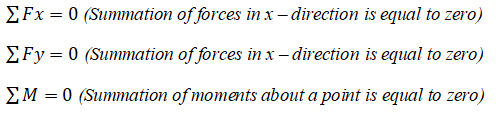
  Reactions as what support offers to restrain structure to its position, when subjected to loadings. As the degree of indeterminacy of determinate structure n= 0, this means the reactions or forces are balancing each other with no extra reaction (structure is in equilibrium). Due to balancing reactions, the reactions can easily be determined by using three equilibrium equations for the plane structure, which are the following The magnitude and direction of support reactions in determinate structure can easily determined by adhering the following procedures ·          Drawing free body diagram FBD ·          Check for determinacy ·          Applying equilibrium equations Example 1 Determine support reactions of the structure below Solution The first step is to draw free body diagram, this diagram show the directions (proposed) and position o...
INTRODUCTION TO STRUCTURAL ANALYSIS...PART ONE

Image
Everyday construction activities are done for erection of different structures, the erected structures should be designed so they can be safe and serviceable for desired lifetime. One of the important stages in designing structures so that they can be safe and serviceable is structural analysis. Structural analysis is an integral part of structural design which deals with determining the stresses and resistance of structure to the loading. In analysis loads or stresses can be classified as external loads and internal loads, where by external loads(stresses) comprises of applied loads and reactions while internal   loads comprises of resultant forces, axial forces, shear forces and bending moment. Reactions and supports Support is any structural member that is provided to carry or provide support to a loading. Reactions are   what the support offer as resistance when subjects to loading, so these are forces offered by supports to restrain the structure. Reaction...

INTRODUCTION LOADS ESTIMATION...PART ONE

Image
  LOADS ESTIMATION In construction industry, structures such as dams, buildings, Retain walls, roads, railways and bridges are constructed to carry or support loads. So in any construction, the magnitude of the loads expected must be pre-determined, loads that structures are subjected to can be classified with accordance to their sources as dead loads, live loads and environmental loads. Dead loads are loads from structural members of the structure and other materials or finishes attached to it. Live loads these are loads generated due to the use of the structure such as people, imported furniture, machine and vehicles. Environmental loads theses are loads from surroundings around the structure such as wind, snow and earthquakes Different loads types have different way to measure or estimate its magnitude, loads that structures carry from structural members which can be expressed as point load (Newton, N) or distributed load (Newton /meter, N/m) can be calculated as s...

PHASES OF STRUCTURAL DESIGN WORKS

Image
 Structural Design is the design technology which aim at determining the appropriate sizes and materials of structural members that form a structure, the determined sizes and material should formulate safe and serviceable structure at acceptable cost (minimum cost). PHASES OF STRUCTURAL DESIGN WORKS This explains different stages followed for accomplishment of structural design work of different structures either whole or member of the structure. The following are the involved stages Preliminary structural design In this phase the sizes (dimensions) of different structural members forming structure are proposed in approximate by referring experience and code requirement. The proposed dimensions of the members are the one which used in next stage of design that is load estimation. Estimation of loads This involved the estimation of amount of loadings that the structure will have to carry on its life time; this includes wind loads, live loads and self weight. Structur...

CHEMICAL ADMIXTURES IN CONCRETE

Image
  CHEMICAL ADMIXTURES IN CONCRETE   A material other than water, aggregates, or cement that is used as an ingredient of concrete or mortar to control setting and early hardening, workability, or to provide additional cementing properties. Mostly of people are having some contradiction on considering additives as admixtures although both alter some properties, but they are put on different substances since additives are put during cement production while admixtures are put during concrete mixing. Reasons for using admixtures To suitable concrete of certain properties for complex structures. For economic purposes For maintaining quality of concrete during all stages of concrete work Admixtures can be divided into two categories as follows Mineral admixtures Chemical admixtures In this post will talk more about chemical admixtures as used in modifying properties of fresh and hardened concrete. Chemical admixtures these are water soluble compounds that are adde...

PRINCPLE PROPERTIES OF FLUIDS

Image
  PRINCPLE PROPERTIES OF FLUIDS         Fluids is the substance that deform continuously under shearing force, also these are substances    that can flow include liquid and gas. Fluid mechanics is the study which deals with fluids, their properties and forces on them. Fluids have three major properties which are Density Viscosity Surface tension These are very important properties to be discussed so as to know how fluids behave in different situations. Density This is the quantity of substance present in it per unit volume, density of substances can be expressed in different ways as follows                  1.  Mass density This is the mass of the substance per unit volume; mass density is expressed in kilogram per cubic meter as kg/m3.         2.   Unit weight of specific weight              ...